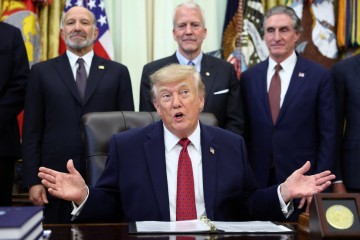
US President Donald Trump on Wednesday unveiled South Korea's US investment projects under last year's bilateral trade agreement: the construction of a gas-fired power plant in Texas, eight large-scale nuclear power plants and a liquefied natural gas project in Alaska.
The announcement followed protracted negotiations over major energy infrastructure projects under the agreement that committed South Korea to investing $350 billion in the United States -- $150 billion for the shipbuilding sector and the remainder for strategic investments -- in return for lower US tariffs on Korean goods.
Trump's explanation of the first investment package under the agreement suggested apparent differences with Seoul's position that the two countries have largely agreed on the Texas and nuclear projects, while Korea's participation in the Alaska project has yet to be finalized.
Trump highlighted the investment projects as he has underscored his economic achievements ahead of the November midterm elections amid public concerns over the monthslong war with Iran that has resulted in high energy prices and deepened economic uncertainties.
"(South Korea) will invest up to $200 billion ... to build a 6-gigawatt power generation facility in Texas. That's a major plant. That's about as big as you will see, (and) eight new large-scale nuclear power plants," Trump said at the White House.
"And at long last, Alaska liquefied natural gas pipeline. That's a big one," he added.
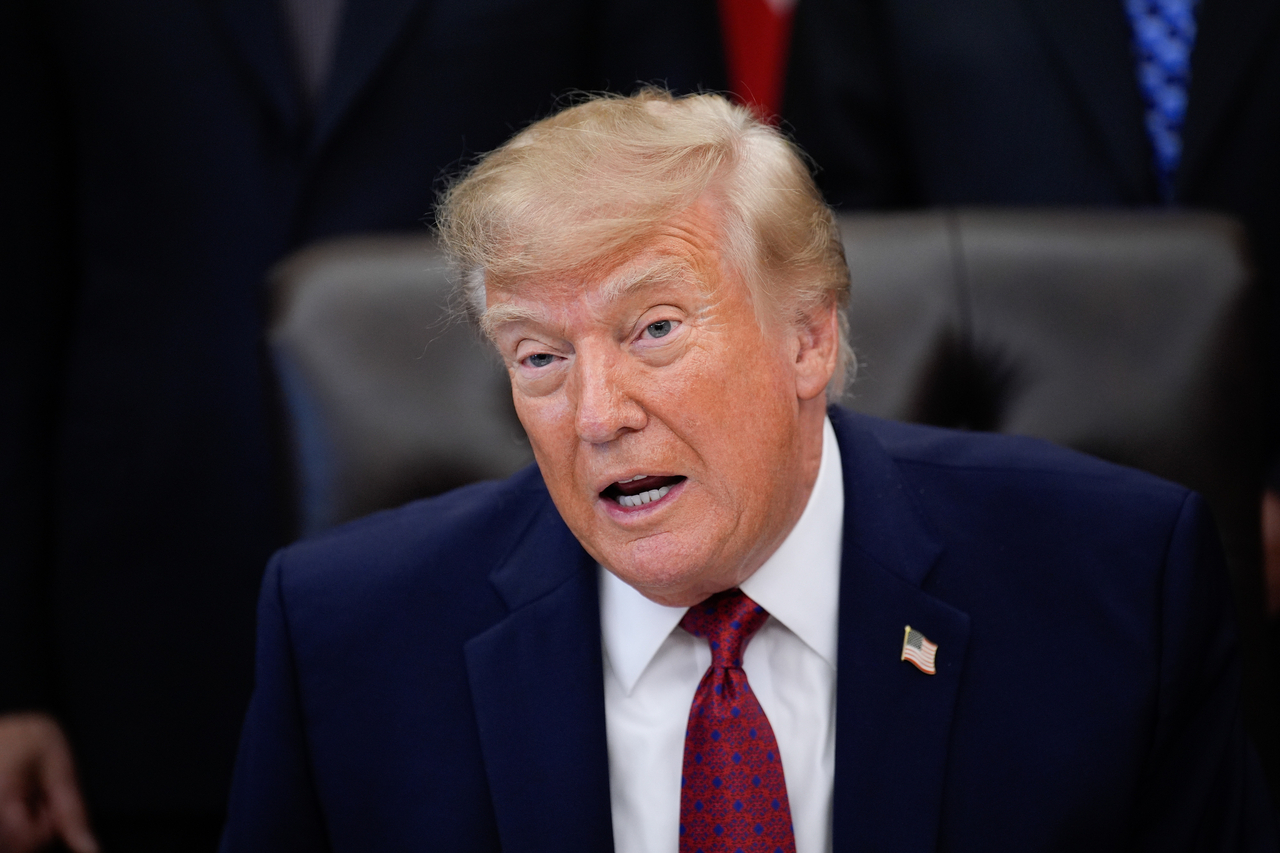
In a social media post later, Trump said that he and South Korean President Lee Jae Myung agreed to "launch" $200 billion of new investments in the US when they recently met on the sidelines of the UN General Assembly in New York.
Trump touted the set of three projects as "the colossal package," saying it marked a "major step towards securing our critical energy supply chain, ensuring American energy dominance and making our partnership with South Korea and the entire Pacific region stronger than ever before."
"The natural gas power plant that will be constructed in Texas will be among the largest ever built anywhere in the world. The eight new nuclear reactors built across the country will solidify our position as the world's leading producer of nuclear power," the president said.
He added, "By building the Alaska LNG pipeline, we will deliver nearly 4 billion cubic feet of LNG per day, and that puts us at a level that is not comparable with anyone else."
The LNG project involves the construction of a 1,298-kilometer-long pipeline from the North Slope, which has massive proven natural gas reserves, to southern Alaska to transport natural gas that will be cooled to liquid form for shipments to Asia.
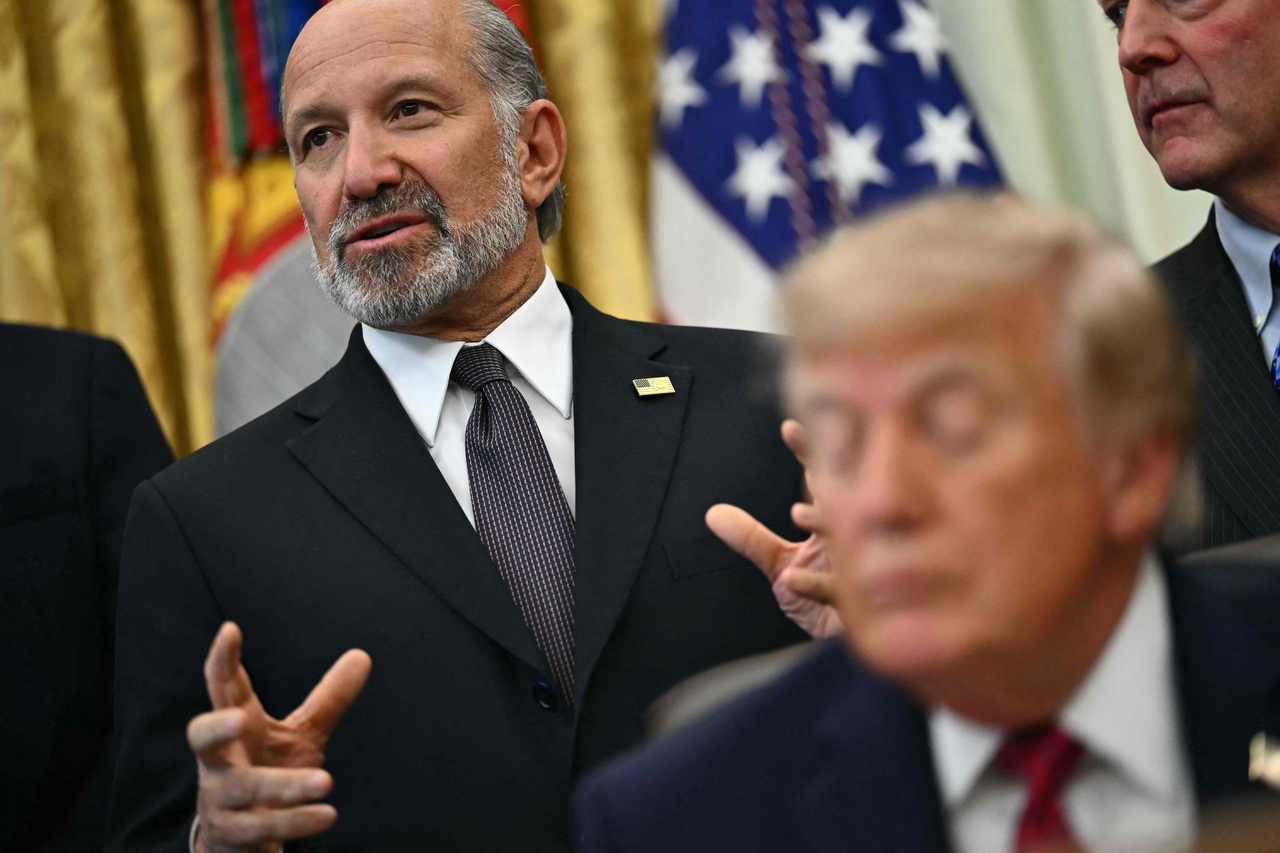
Trump made the announcement alongside Commerce Secretary Howard Lutnick, Interior Secretary Doug Burgum, Energy Secretary Chris Wright and Sen. Dan Sullivan (R-AK), calling the investment plans "one of the largest energy infrastructure investments in American history."
Later, the Commerce Department released a fact sheet outlining the projects for the Texas plant, nuclear reactors and the Alaska LNG project, which it called "Project Star," "Project Power" and "Project North," respectively.
"The plan announced today will expand the stable power supply needed for AI and strategic industries, strengthen critical supply chains, and contribute to enhancing the energy, economic, and national security of both countries," the department said.
Estimated to cost $22.3 billion, Project Star features the construction and operation of a combined-cycle gas power plant in Encinal, La Salle County, Texas, the department said, noting that the plant will begin its commercial operation in 2029 and reach its full-capacity operation in 2032.
The project will support the stable operation of artificial intelligence data centers while promoting Korea-US cooperation in the energy and infrastructure sectors, it added.
Project Power includes a blueprint for the construction of eight nuclear power plants, which integrate two units of a Korean-designed reactor model, APR1400, and six units of a US-designed reactor model, AP1000.
The funding for the nuclear project totals $120 billion -- $100 billion for construction costs, or overnight costs, and $20 billion for contingency reserves, the department said.
"By combining US technological expertise with Korea's supply chain capabilities and leveraging successful deployment cases in the United States, the two parties will broaden their strategic, long-term cooperation in the global nuclear power market," the department said.
"The parties will develop and announce individual projects separately as sites, schedules, and commercial terms are finalized."
At the event announcing the projects, Lutnick said eight "gigantic" nuclear power plants will be built across the US, including in Ohio, Tennessee, South Carolina and Kentucky.
On Project North, the department said that the "two countries have agreed to commence working on the Alaska LNG project, subject to meeting 'commercial reasonableness' under the Strategic Investment memorandum of understanding and all applicable domestic legal requirements."
It was referring to the MOU on South Korea's investment commitment.
Lutnick said that over $50 billion will be invested in the Alaska project.
South Korean President Lee and Trump reached the trade agreement during their summit in South Korea last October. In return for Seoul's investment commitment, Washington agreed to lower its now-invalidated "reciprocal" tariffs on South Korean goods to 15 percent from 25 percent.
South Korea and the US had engaged in difficult negotiations over the selection of investment projects amid Seoul's efforts to ensure "commercial viability" in those projects. (Yonhap)
![[Legal updates in Korea] New insurance mandate protects firefighters on the job](https://wimg.heraldcorp.com/news/cms/2026/10/01/news-p.v1.20261001.76835f19eb424f18814ac3bb65d896a9_T1.jpg?type=h&h=800)